In Sync With Ourselves: A World Mental Health Day Reflection
Reflect on mental wellbeing this World Mental Health Day. Learn why our minds feel overloaded, and discover science-backed habits and technology tools that restore balance.
Reflect on mental wellbeing this World Mental Health Day. Learn why our minds feel overloaded, and discover science-backed habits and technology tools that restore balance.
Today, 10 October 2025, is World Mental Health Day, a global reminder that behind every inbox, calendar invite, and endless to-do list, there is a human mind working steadily to keep up. ❤️🩹
At InsideSync, we invite you to pause for a moment.
Take a breath.
This is your space to reflect, reset, and reconnect with what’s happening inside you, not just what’s happening around you.
In this article, we explore why mental health matters more than ever, what’s disrupting our internal balance, and the small, science-backed steps (and yes, even technology) that can help us get back in sync.
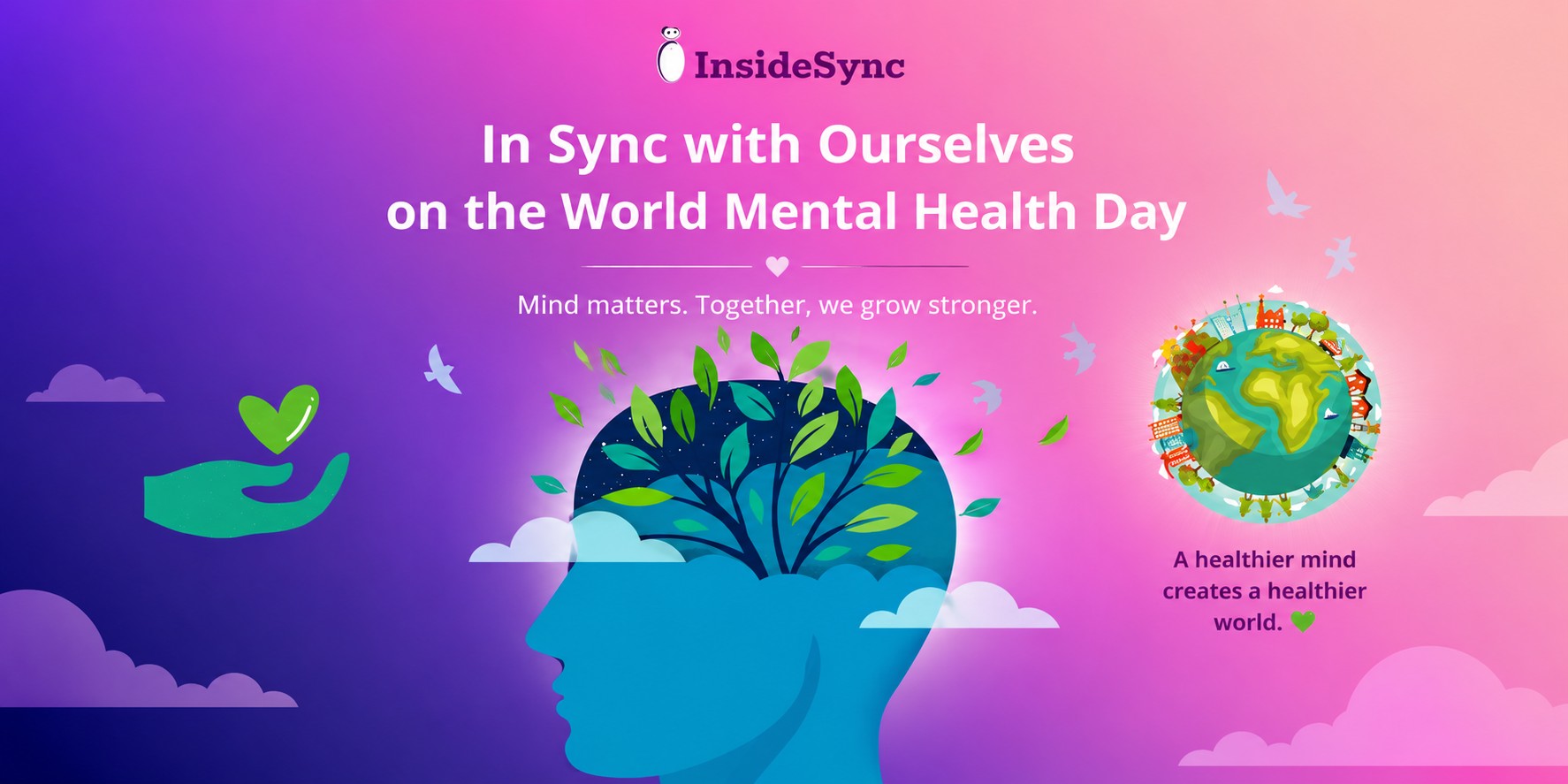
Mental health affects everything: our relationships, our focus, our emotional resilience, and even how our bodies heal. Yet, it remains one of the most misunderstood dimensions of wellbeing.
According to the World Health Organization,
👉 1 in 4 people will experience a mental health challenge at some point in their lifetime. The global impact is enormous.Studies estimate that depression and anxiety cost the world roughly US $1 trillion each year in lost productivity.
But beyond numbers, there’s a deeper truth:
Your mind isn’t separate from your work – your mind drives your work.
When we feel safe, rested, and connected, the prefrontal cortex – our brain’s center for problem-solving and creativity – becomes more active.
When we’re exhausted or stressed, that centre dims.
Looking after your mental health isn’t self-care fluff.
It’s cognitive maintenance.
It’s how you protect the part of your brain that helps you think, imagine, create, lead, love, and grow.
We live in an era of constant stimulation.
The average person checks their phone over 150 times a day, often without even realizing it.
Every notification triggers a small burst of dopamine, conditioning our brains to chase micro-rewards.
But here’s the hidden cost:
⚡ It fragments attention
⚡ It increases cortisol (the stress hormone)
⚡ It creates attentional residue
Attentional residue is a neuroscientific term describing what happens when part of your mind stays stuck on the last thing you were doing.
The more often we switch, the more residue builds – like digital dust that clutters our mental clarity.
No wonder so many of us feel mentally foggy even when we’re “resting.”
Our brains were designed for rhythm: focus → rest → reflect. Not endless scrolling.
The good news?
Your brain is adaptable.
Tiny habits – consistently practiced – can reset your internal rhythm.
🚶♀️ Movement
Just 10 minutes of brisk walking can release endorphins and serotonin, boosting mood and energy.
🌬️ Breathing
A 2023 Stanford study found that one minute of slow, intentional breathing (five seconds in, five seconds out) reduces anxiety even faster than popular meditation apps.
😴 Sleep
Sleeping less than 7 hours makes the amygdala – your brain's alarm system – up to 60% more reactive. Protecting your sleep is protecting your emotional stability.
🤝 Connection
Harvard’s 85-year study on adult development identified one powerful predictor of long-term happiness:
👉 The quality of our relationships, not income or status.
These are small levers, but they compound – like interest in your emotional bank account.
It’s easy to blame technology for modern stress. And yes – it often plays a role.
But when used intentionally, technology can also become a powerful ally.
Think of it as a mirror instead of a master.
Modern tools can:
Imagine a world where your calendar doesn't just manage meetings –
It notices when your day is overloaded and prompts you to pause.
Where your wearable gently nudges you when stress spikes.
Where AI helps you maintain balance instead of pushing you past your limits.
This is the future of empathetic technology – tech that supports your wellbeing, not steals it.
At InsideSync, that’s the direction we’re building toward: Tools that help you notice yourself again.
Because the goal isn’t perfect productivity.It’s peaceful effectiveness.
Today, we invite you to ask yourself:
🧡 How’s my mind today?
🌤️ What’s one small thing I can do to feel lighter?
Maybe it’s stepping outside.
Maybe it’s closing your laptop 10 minutes earlier.
Maybe it’s deciding that enough is enough for now.
Remember:
You are not a machine to be optimised.
You are a human being designed to think, feel, rest, and grow.
Thank you for taking this moment with us.
Stay kind. Stay curious.
And keep your mind – and your world – in sync. 🌿

Mental Health
Nana Le - CEO & Founder of InsideSync · 12/13/2025
Productivity
Nana Le - CEO & Founder of InsideSync · 11/30/2025

Mental Health
Nana Le - CEO & Founder of InsideSync · 11/18/2025